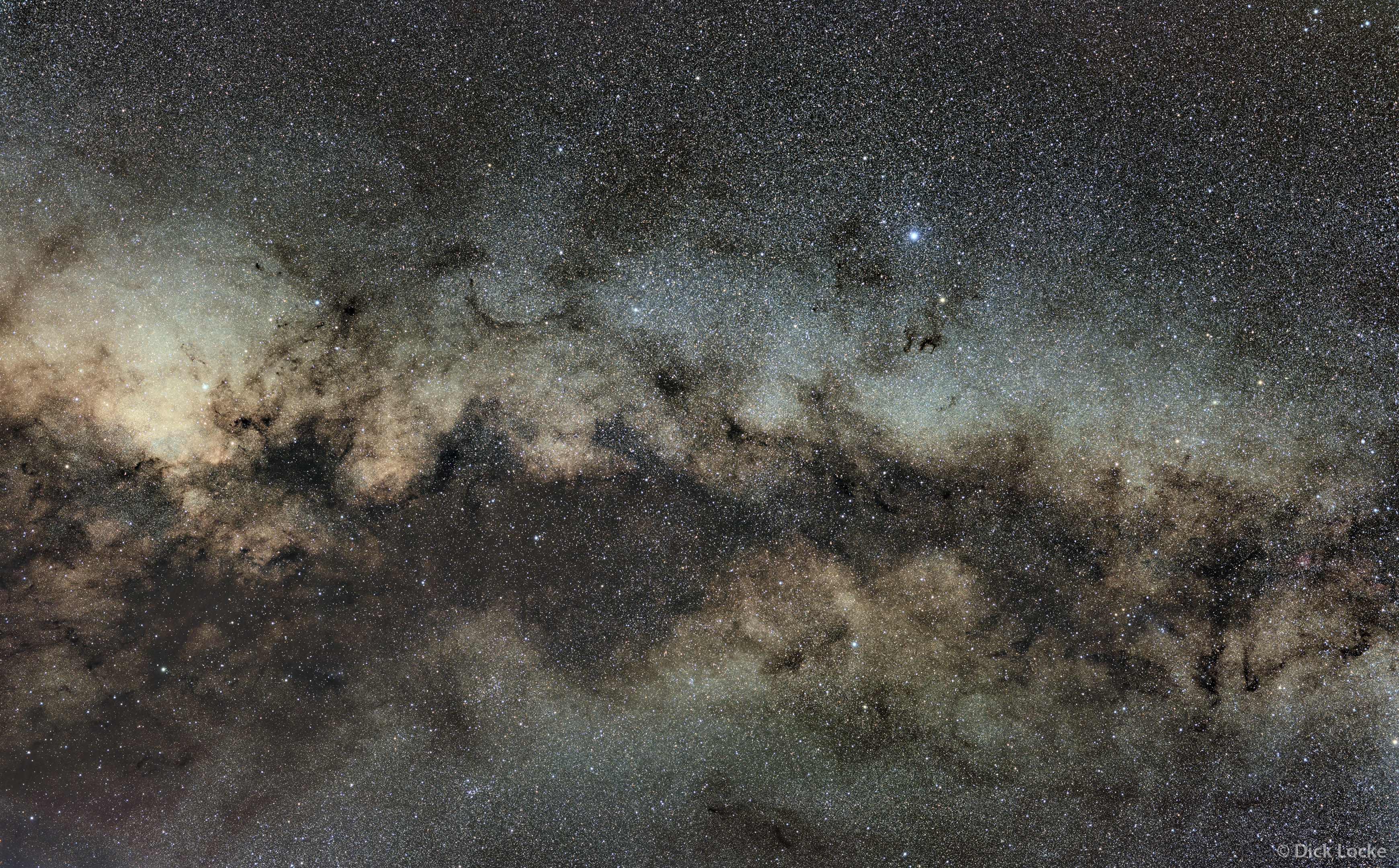
Revised: The Aquila Milky Way Rift
There is a higher resolution of this image at Astrobin
here.
Aquila D810a 50mm August 11 2026 Starry Nights
PixInsight Restacked - This image shows part of the Milky Way’s Great Rift in Aquila. It’s also known as the Aquila Rift or Serpens-Aquila Rift). According to Wikipedia it’s comprised of a “dark cloud of cosmic dust that obscures the middle of the galactic plane of the Milky Way, looking inwards and towards its other radial sectors. The clouds that form this structure are called "molecular clouds", constituting a phase of the interstellar medium which is cold and dense enough for molecules to form, particularly molecular hydrogen (H2). These clouds are opaque to light in the optical part of the spectrum due to the presence of interstellar dust grains mixed with the gaseous component of the clouds. Therefore, the clouds in the Serpens-Aquila Rift block light from background stars in the disk of the Galaxy, forming the dark rift. The complex is located in a direction towards the inner Galaxy, where molecular clouds are common, so it is possible that not all components of the rift are at the same distance and physically associated with each other.”
There are dozens of dark Nebulae in the Barnard catalog shown in the above image, for example, Barnard's E is on the upper right part of the picture, below the bright blue and orange stars. See lower on this web page for a close-up of that. The chart below also show many of the deep space objects in the field of view.
This image was integrated using PixInsight, which resolved an issue experience with the DSS stack (an image with that processing and a different color balance is also lower on this web page).
Technical Info: 63 minutes total exposure (63x1min) on a Nikon D810A camera with a Sigma Art 50mm f1.4 lens at f2.8 and ISO 800. The Sky-Watcher Wave 150i Strainwave Mount was used to track the sky (no autoguiding). Image processed in PixInsight and Photoshop.
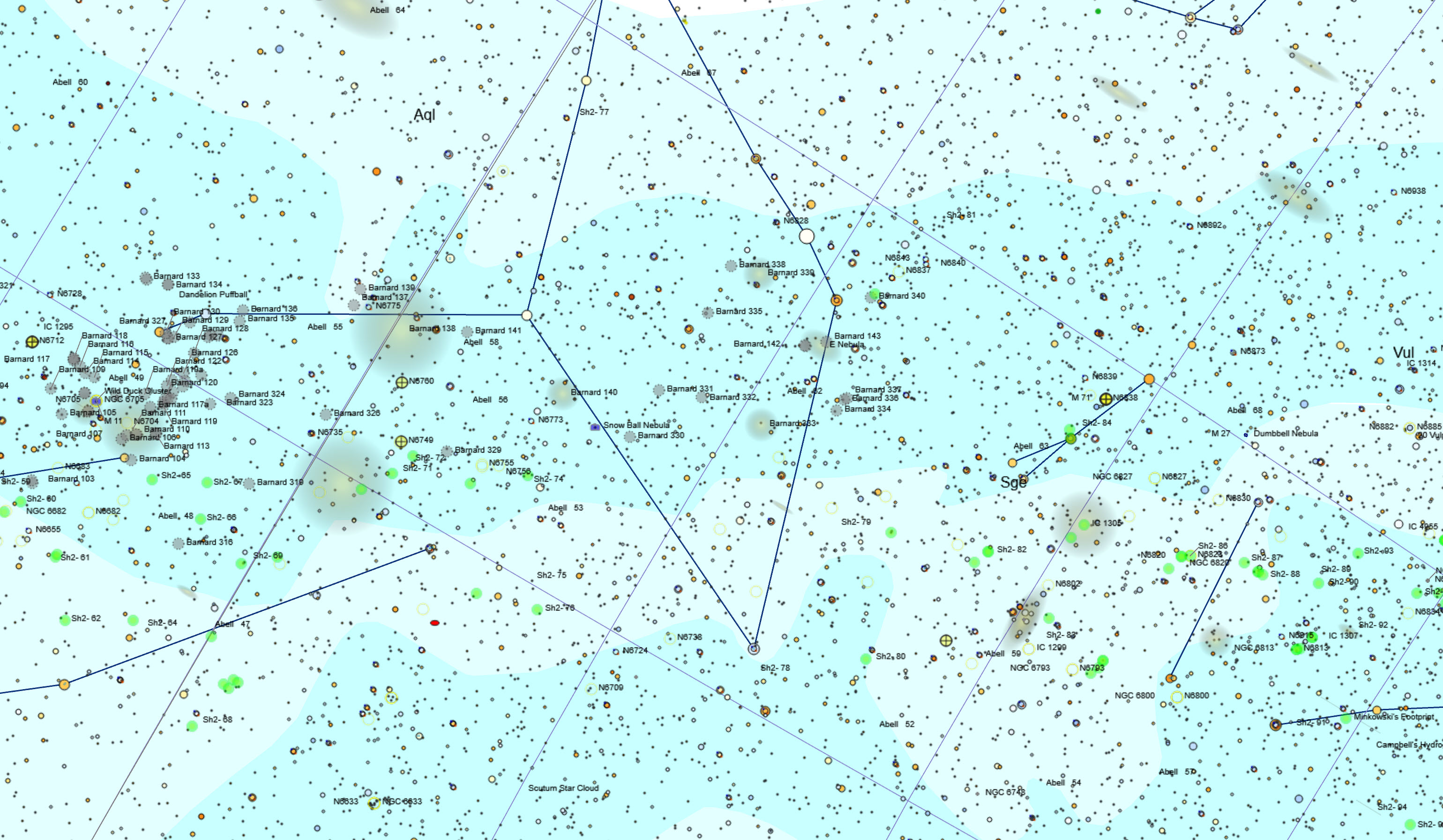
Above is a screen shot from TheSkyX Pro software that shows all the Barnard objects in the region among other things.
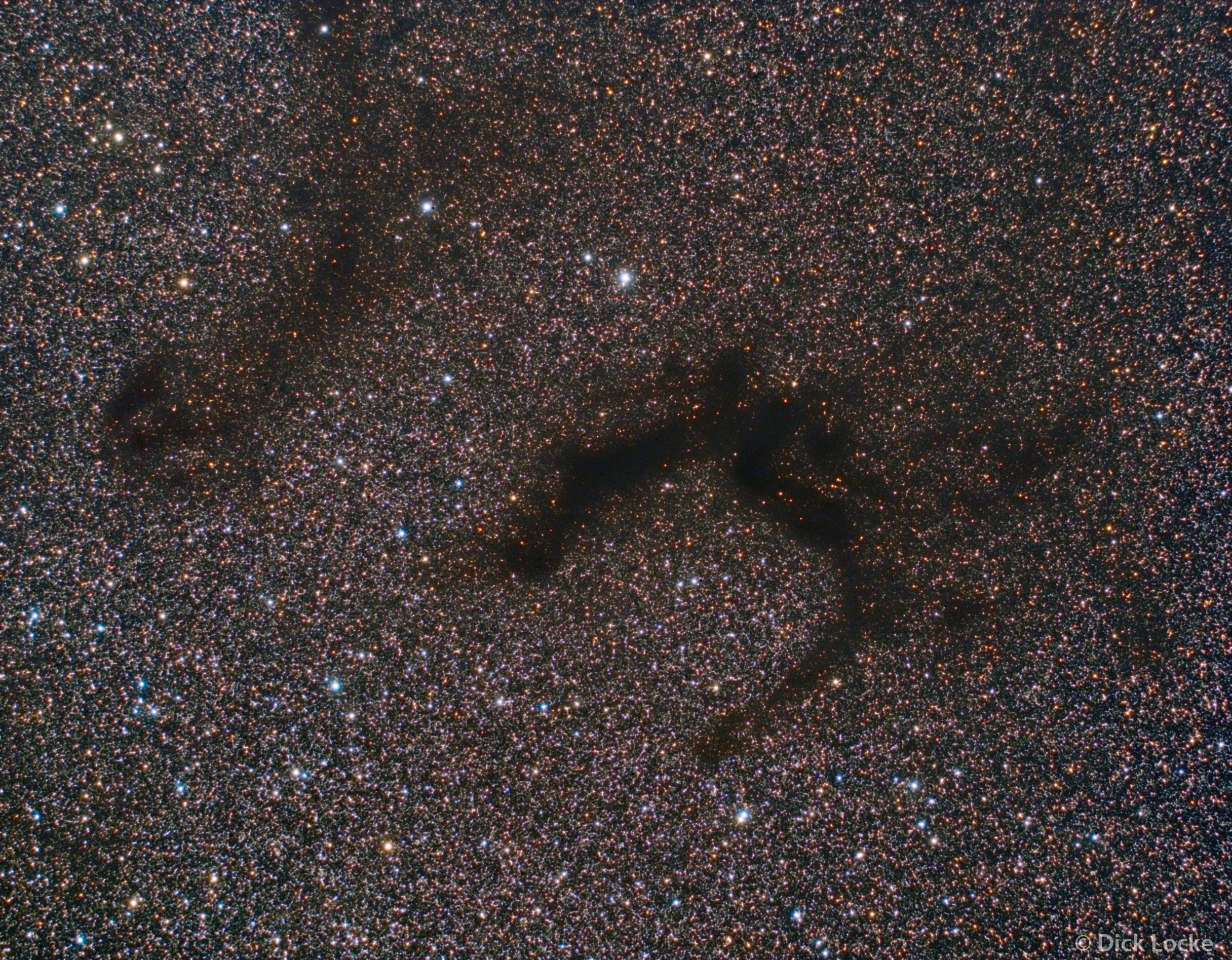
Barnard's E, cataloged as Barnard 142 and 143 (B142 and B143) is also known as LDN 694. This is a close-up of the area through a telescope, see it in the wider angle images as well. Exposure: 31x5 minutes, about 2.5 hours, with reducer, revised version posted 11/15/2008. See the wide angle image that includes Barnard's E here. Davis Mountains, October 2008. Takahashi TOA 130 Telescope (a 5" APO refractor telescope), AP 900GTO mount, QHY8 CCD Camera. Other pictures from the camera are are here. Images processed using my Astronomy Image Processing Workflow. Other pictures from the 2008 Davis Mountains, Texas, trip are at this link.
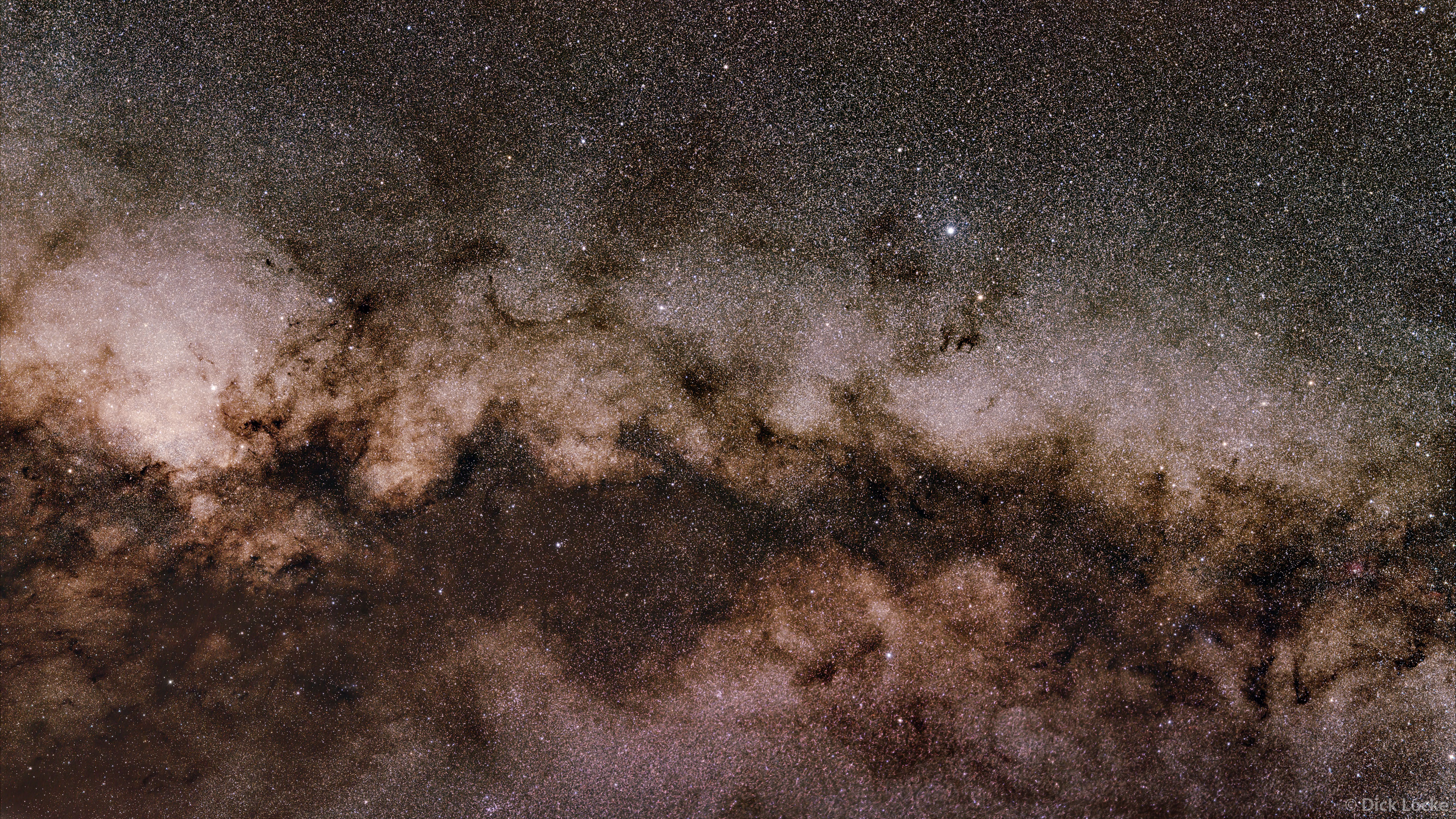
Aquila D810a 50mm August 2026 Starry Nights, posted October 2026.
This image show the Great Rift, the nearby dark cloud of cosmic dust that obscures the middle of the galactic plane of the Milky Way, looking inwards and towards its other radial sectors. The clouds that form this structure are called "molecular clouds", constituting a phase of the interstellar medium which is cold and dense enough for molecules to form, particularly molecular hydrogen (H2). These clouds are opaque to light in the optical part of the spectrum due to the presence of interstellar dust grains mixed with the gaseous component of the clouds. Therefore, the clouds in the Serpens-Aquila Rift block light from background stars in the disk of the Galaxy, forming the dark rift. The complex is located in a direction towards the inner Galaxy, where molecular clouds are common, so it is possible that not all components of the rift are at the same distance and physically associated with each other.
Technical Info: 63 minutes total exposure (63x1min) on a Nikon D810A camera with a Sigma Art 50mm f.14 lens at f2.8 and ISO 800. The Sky-Watcher Wave 150i Strainwave Mount was used to track the sky (no autoguiding). Image processed in Deep Sky Stacker, PixInsight, and Photoshop. This image is stacked in DSS and there was some sort of issue at the bottom where a section was blurry. Reprocessing in PixInsight corrected that, the corrected image is now on top of the page..

Here's a wide-field Milky Way image from the Hill Country October 2017 trip. Open cluster M11 is buried in the bright Scutum star cloud on the upper left. Altair in Aquila is the bright star to the right of center. I did my best to deal with the gradients present in the original (i.e., the part closest to the horizon was much brighter than areas higher in the sky). This is composed of 35 minutes total exposure (7x5 min) using the Nikon D810A camera and the Sigma Art 50mm lens at f2.8


This milky way area includes "Barnard's E", in Aquila, as well as Sagitta, Vulpecula, and south Cygnus. Barnard's E is on the upper left, below the bright orange star Tarazed (50 gamma Aquilae). See a close-up of Barnard's E on my dark nebula page (scroll down).
5 frames * 5 minutes each from QHY8 CCD Camera using a the Nikon 55mm f2.8 micro lens at f4. Other pictures from the camera are are here. AP 900GTO mount.
Cygnus Area Astrophotography Index
Dick Locke's Astrophoto Gateway page....
Images Home
Contact and Image Use Information